“What if I received rent in addition to my monthly salary?”
“If I had another source of income besides my pension, I might be able to choose how I work.”
Have you ever felt interested in real estate investment like that?
Real estate investment is a type of “income” investment where you rent out a purchased condominium or house and receive rent in return.
However, you cannot use all of the rent you receive.
In this article, I would like to help you get an idea of real estate investment by focusing on the flow of money.
-
What do you buy, and how is rental income generated?
-
What does the “yield” in property information mean?
-
How much is left after deducting expenses and loan repayments from the rent?
-
If you keep holding the property, how do your cash on hand and loan balance change?
“The rent has come in, what happens next?”
Let’s take a look together!
1. The Mechanism of Real Estate Investment | How is rental income generated?
– Providing a “home” and receiving rent in return
Buying a home for yourself to live in is a personal residence.
Buying a property to rent out to someone else and receive rent is an “investment property.”
For example, suppose you buy a condominium unit and rent it out for 80,000 yen per month.
The tenant lives there, and “you,” the landlord, receive “rent” in exchange for providing the home.
This rent is the “income” generated from the real estate.
Rent of 80,000 yen per month amounts to 960,000 yen in annual income over 12 months.
However, while the unit is vacant, no rent is received from that room.
In other words, income is not generated just by buying real estate; it only leads to “rental income (income)” when there is someone living there.
First, let’s understand this relationship.
– The “Standard” Scheme of Real Estate Investment | ~Owner, Tenant, and Management Company~
“How do you find tenants?“
“Do I have to do everything myself, including advertising and subsequent responses?”
If you are working as a company employee, these are points of concern, aren’t they?
The solution to that is to outsource property management operations to a management company (real estate company).
Specifically, this involves hiring a rental real estate company you see in front of train stations—often with green or blue signs—to handle tasks such as recruiting tenants, mediating contracts, collecting rent after move-in, and responding to inquiries, a method adopted by many salaryman landlords.
Illustrated, it looks like this.
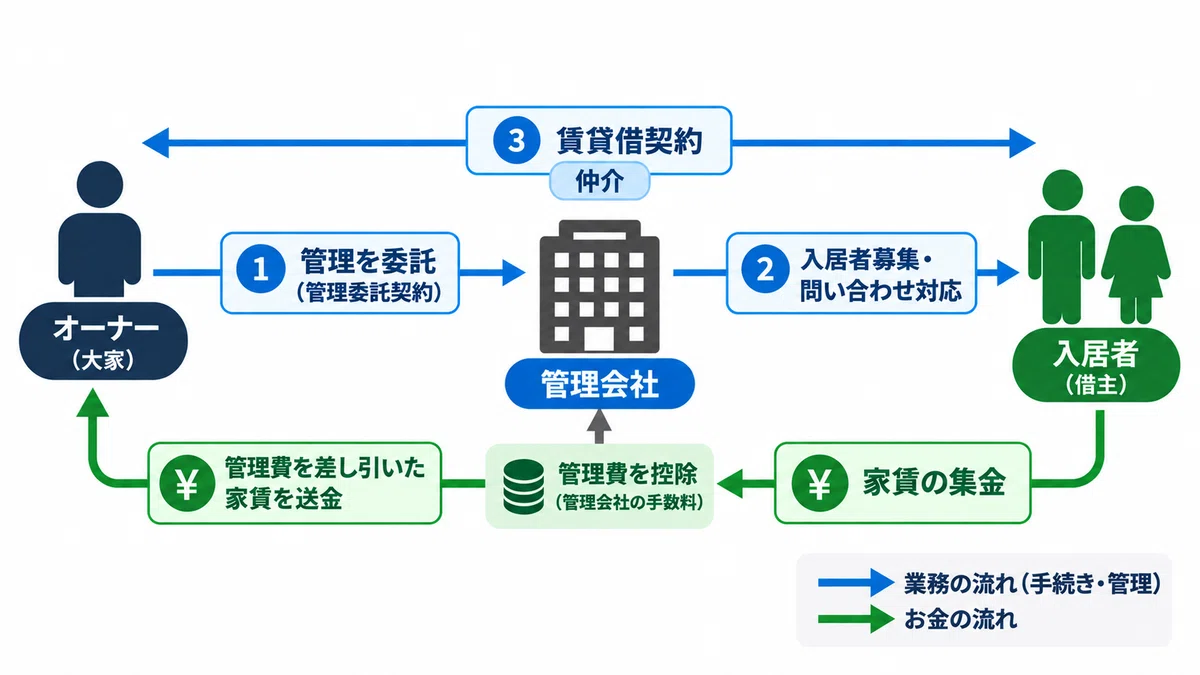
However, you cannot leave everything entirely to them. It is an important role of the owner to receive repair proposals and decide whether to implement them, as well as to check income and expenditures.
Therefore, real estate investment also has the aspect of “rental management,” which involves maintaining the residence and continuing to rent it out.
*How to delegate to management companies and tips for rental management will be covered in detail in a separate article.
Rent out a residence,
borrow the strength of a management company,
and receive rent (income).
Has the flow of how rent, as “income,” reaches the owner become a little clearer?
Next, let’s look at what kinds of real estate generate that rent.
2. Types of Real Estate Investment | Condominium Units, Detached Houses, and Whole Buildings
Even when talking about investment real estate, there are various types, such as renting out a single condominium unit, renting out a detached house, or owning and renting out an entire apartment building.
An important point here is that depending on the type of property, the way rent is received, the scope of maintenance and management, and the situations where money goes out also change.
Let’s look at three representative types.
– Condominium Unit | Owning a single room in a condominium
For example, this is a method where you purchase only “Room 305” of a condominium and rent it to a tenant.
Rent is received from the tenant of that room, but if it becomes vacant due to move-out, rental income during that period will be zero.
On the other hand, common areas such as condominium hallways, elevators, and exterior walls are generally maintained and managed through a management association. Therefore, the owner pays management fees and repair reserve funds every month.
The management fee referred to here is money separate from the “fee to the management company entrusted with tenant support, etc.” explained in the previous chapter.
Also, remember that even in months when there is no tenant, payments such as management fees and repair reserve funds continue.
– Detached House | Owning land and a building as a set
In terms of renting out a house and receiving rent, it is the same as a condominium unit.
The difference is that because you own the land and the building together, the owner is also responsible for deciding on and paying for the maintenance and repairs of the building’s exterior walls, roof, and facilities.
While there are basically no “management fees” or “repair reserve fund” payments to a management association like there are with condominium units, you must prepare the money needed for future repairs yourself.
For example, if a water heater breaks or the roof needs repairs, you may face a significant lump-sum expense.
Also, when a tenant moves out, the rental income for that home becomes zero.
– Entire Apartment Buildings/Condominiums | Owning multiple units together
For example, in an apartment with 6 units, rent is generated for each occupied room, and even if one room becomes vacant, if the other 5 are occupied, the rental income for those units continues.
However, if there are many rooms, there are also more facilities, and since you need to manage the entire building, including hallways, stairs, exterior walls, and the roof, it is important to prepare funds for repairs and the like.
While rent comes in from multiple rooms, the owner also bears the maintenance costs for the entire building. This is a major characteristic of entire-building properties.
– Purchase price and repair outlooks differ between new and used properties
In addition to the three types mentioned so far, another thing to know is the difference between “new” and “used.”
New properties may require fewer major repairs immediately after purchase, but the property price can be higher. Being new does not guarantee occupancy or rental income.
Used properties may have lower purchase prices, but depending on the condition of the building and facilities, repair costs may be needed shortly after purchase.
In other words, you cannot determine which is more advantageous just by whether it is new or used.
I have explained the characteristics of typical properties so far, but you are probably wondering, “…so, which one is better in the end?”
“Condominium units” and “detached houses” include properties that can be started with relatively little capital, while “entire apartment buildings/condominiums” require a significant amount of capital but have the characteristic of being able to earn rental income from multiple rooms.
So, what criteria should you use to choose?
What is important is not the amount of rental income, but the money that actually remains in your hands.
From the next chapter, I will explain points for choosing investment properties and simulations of remaining cash.
First, let’s look at the “yield,” which is a guideline for how much rental income can be expected relative to the money invested.
3. What is real estate yield? | Understand the meaning of “10%”
When looking for investment properties, one of the indicators that Income Jr. values is the “yield.”
When checking property listings, you often see terms like “8% yield” or “10% yield.”
Yield is a figure that represents how much annual rental income can be expected relative to the property price.
Let’s take a look at how it works.
– Gross Yield | A figure representing the relationship between annual rental income and property price
The term often used for investment properties is “gross yield.”
For example,
・Property price: 10 million yen
・Gross yield: 10%
let’s assume there is a property like this.
The rental income expected from this property is as follows.
10 million yen × 10% = 1 million yen/year (approx. 83,000 yen per month)
In other words, the annual rental income is equivalent to 10% of the property price.
By the way, gross yield is calculated using the following formula.
Gross yield (%) = Annual rental income ÷ Property price × 100
– If the yield is 10%, do you get 1 million yen every year?
“1 million yen in annual rental income from a 10 million yen property!”
Hearing that, it sounds attractive, doesn’t it?
However, one thing to note here.
The gross yield shown in property listings is a figure before deducting management fees, repair costs, taxes, and so on.
In reality, the money remaining after deducting these expenses becomes your “take-home pay.”
Also, if a tenant moves out and the unit becomes vacant, you will not receive rent during that period.
In other words, just because the yield is 10% does not mean that 1 million yen will remain in your pocket every year.
Is there a “market rate” for yield!?
Based on what we’ve discussed so far, it seems that the higher the yield, the better the property is as an investment.
However, it is not that simple.
Actually, yields vary depending on the region and property conditions.
Generally, in areas where rental demand is strong and property prices are high, such as city centers, “yields tend to be lower,” while in areas where property prices are relatively low, such as rural or suburban areas, “yields tend to be higher.”
Of course, even in the same region, it varies depending on the age of the building and the condition of the property.
In other words, you cannot determine whether a property is good or bad based solely on the height of the yield.
The important thing is to not judge solely by the yield figure, but to confirm how much money actually remains in your hand.
If you use a loan, you also need to consider monthly repayments.
So, after deducting management fees, repair costs, taxes, and loan repayments from the rent, how much is left?
In the next chapter, we will simulate the monthly and annual balance using the example of a property with a “property price of 10 million yen and annual rent of 1 million yen” introduced here.
4. How much rent income remains? | Simulating the net cash flow for a 10 million yen property
So, how much actually remains in your hand?
We will check the flow of money by dividing it into monthly balance and annual expenses.
– Model property for this case | Purchasing a used detached house for 10 million yen
In this case, we will consider purchasing and renting out the following type of used detached house.
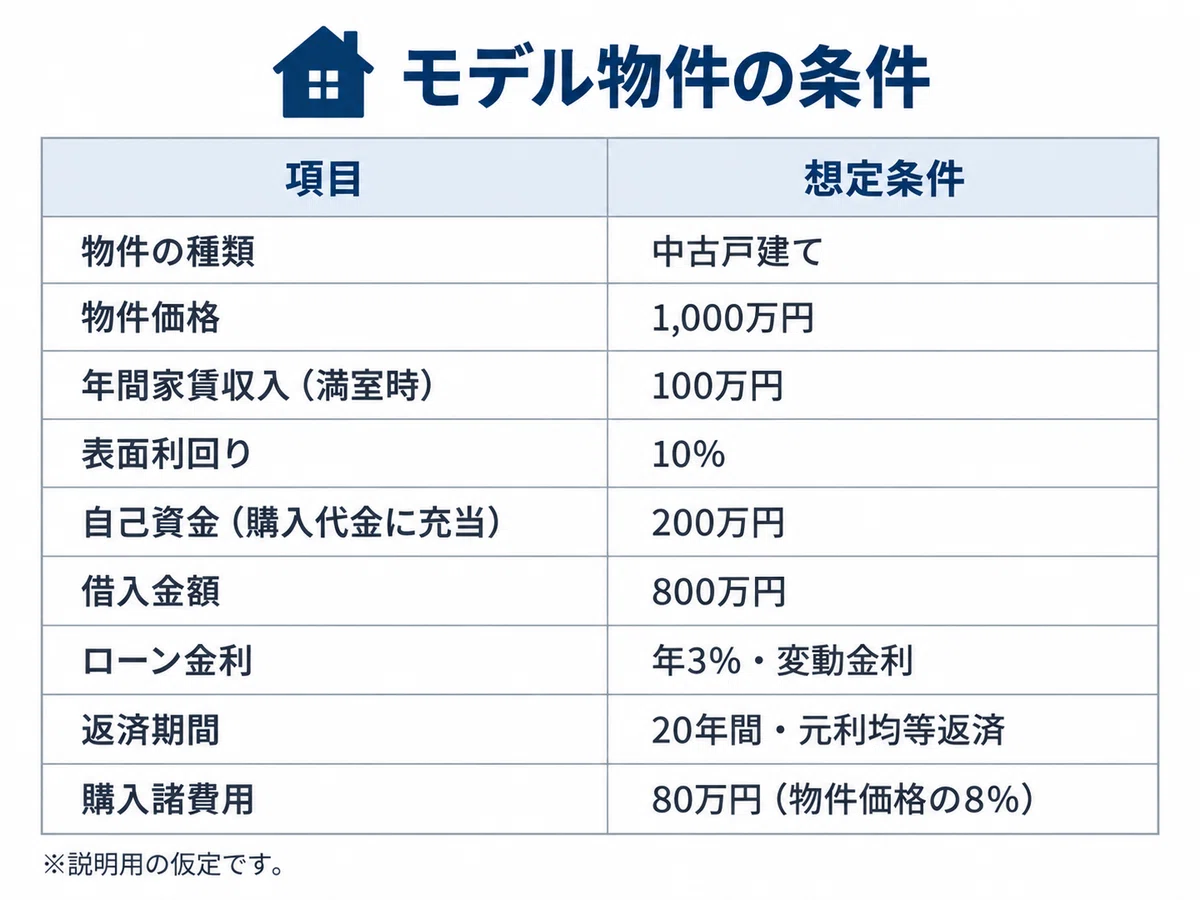
* Assume that purchase expenses (brokerage fees, registration fees, taxes, etc.) are 8% of the property price, which is 800,000 yen.
As shown in the table, the expenses required at the time of purchase are “own funds + purchase expenses,” which is
2 million yen + 800,000 yen = 2.8 million yen
.
Note that we assume a loan with a variable interest rate of 3% per year and a repayment period of 20 years. In this calculation, we assume the interest rate remains constant at 3% per year.
– Money going out from rent | Thinking in terms of monthly and annual
Even when rent comes in, various payments occur for the owner.
Here, let’s check them by the timing of payment.
① Money paid monthly
・Management commission fee: Fees for outsourcing to a management company
・Loan repayment: Money repaid to the financial institution every month
② Money paid during the year
・Fixed asset tax, etc.: Taxes incurred by owning real estate
・Fire insurance premium: Insurance premiums to prepare for building damage, etc.
・Repair costs: Costs incurred for repairs of water heaters, equipment, etc.
Now, let’s actually calculate it.
– Monthly balance | Deducting management commission fees and loan repayments from rent
The monthly balance is as follows.
* Assume management commission fee is 5% of rent, and loan repayment is approximately 44,400 yen per month.
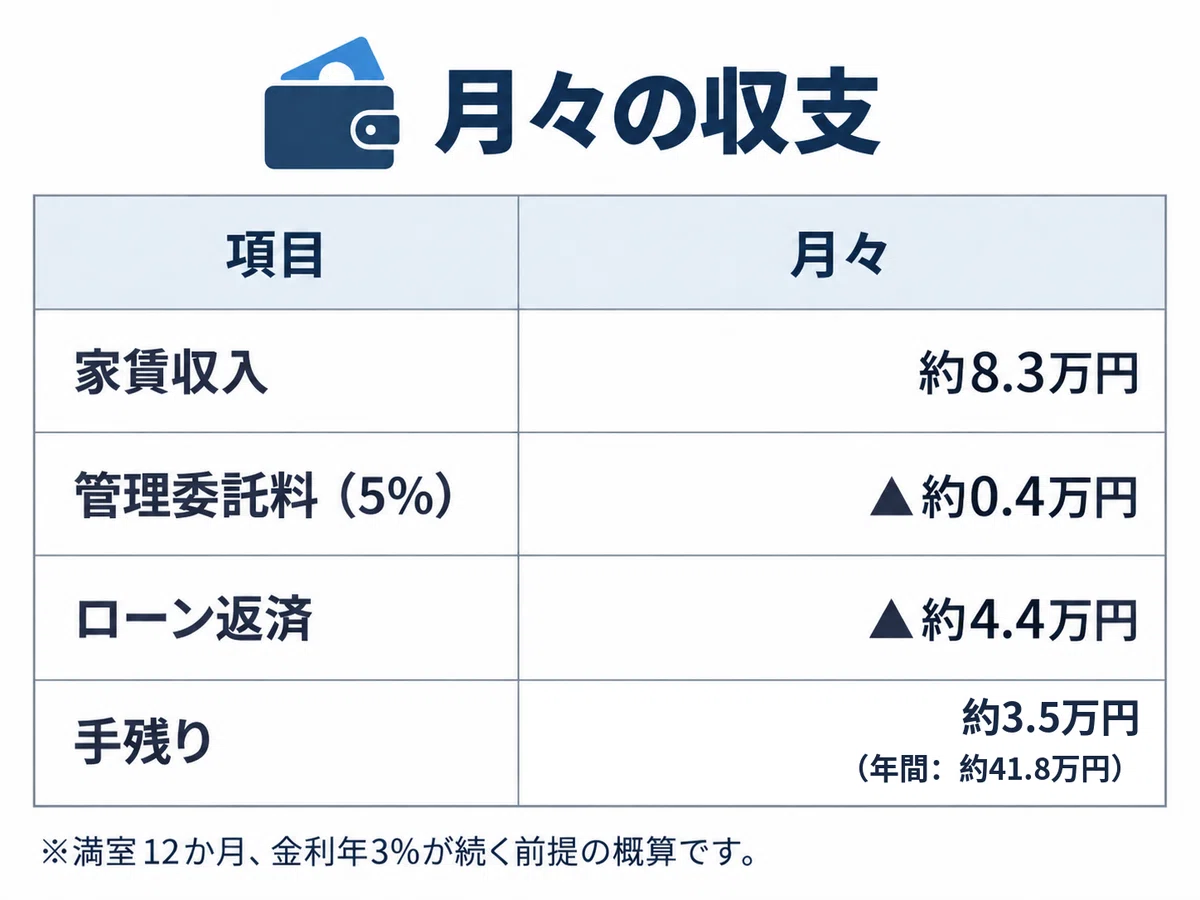
What do you think?
In this case, the monthly remaining amount is approximately 35,000 yen, and if the tenant stays for one year, it will be approximately 418,000 yen per year.
However, it does not end here.
– Annual Balance | Deducting Fixed Asset Taxes, Repair Costs, etc.
Next, we will deduct the money paid throughout the year.
*Assuming annual fixed asset taxes, etc., are 60,000 yen, fire insurance premiums are 20,000 yen, and minor repair costs are 50,000 yen.
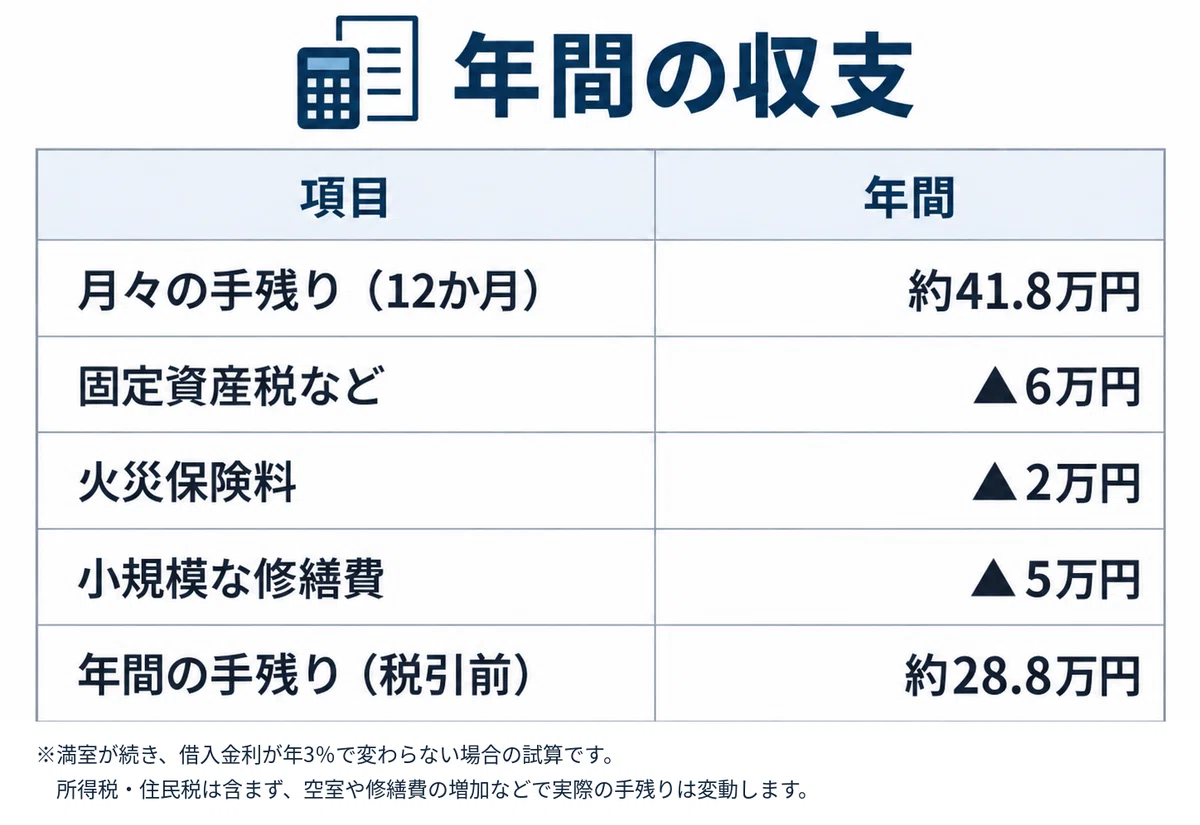
What do you think?
You might feel like, “That’s… less… than I thought.”
However, let’s look at this approximately 290,000 yen from a different perspective.
Against an initial investment of 2.8 million yen, the annual remaining cash is approximately 290,000 yen.
In other words, the “yield on initial investment is approximately 10%“.
Moreover, by repaying the loan from the rent income, the outstanding loan balance gradually decreases, and if the property value remains unchanged, your actual equity increases by that amount.
“There is a change not only in the cash remaining on hand but also in the loan balance.”
This is also one of the characteristics of real estate investment.
In the next chapter, let’s simulate the 10-year balance and changes in the loan balance.
5. What happens if you continue to own investment real estate? | Let’s look at the 10-year balance and loan balance
What happens if you continue to own this property for 10 years?
Real estate investment is characterized not only by annual remaining cash but also by the fact that the loan balance decreases.
Let’s look at the movement of money over 10 years for the same property.
– 10-Year Balance | How does the cash on hand increase?
This time, we will also use the used detached house from Chapter 4 for the simulation.
The conditions are as follows:
・Annual remaining cash: approx. 288,000 yen
・Supplement living expenses with 100,000 yen each year, and save the rest for the future
・Additional repair costs of 300,000 yen occur in the 5th year
・Assuming full occupancy, rent remains unchanged, and the variable interest rate remains at 3% per year
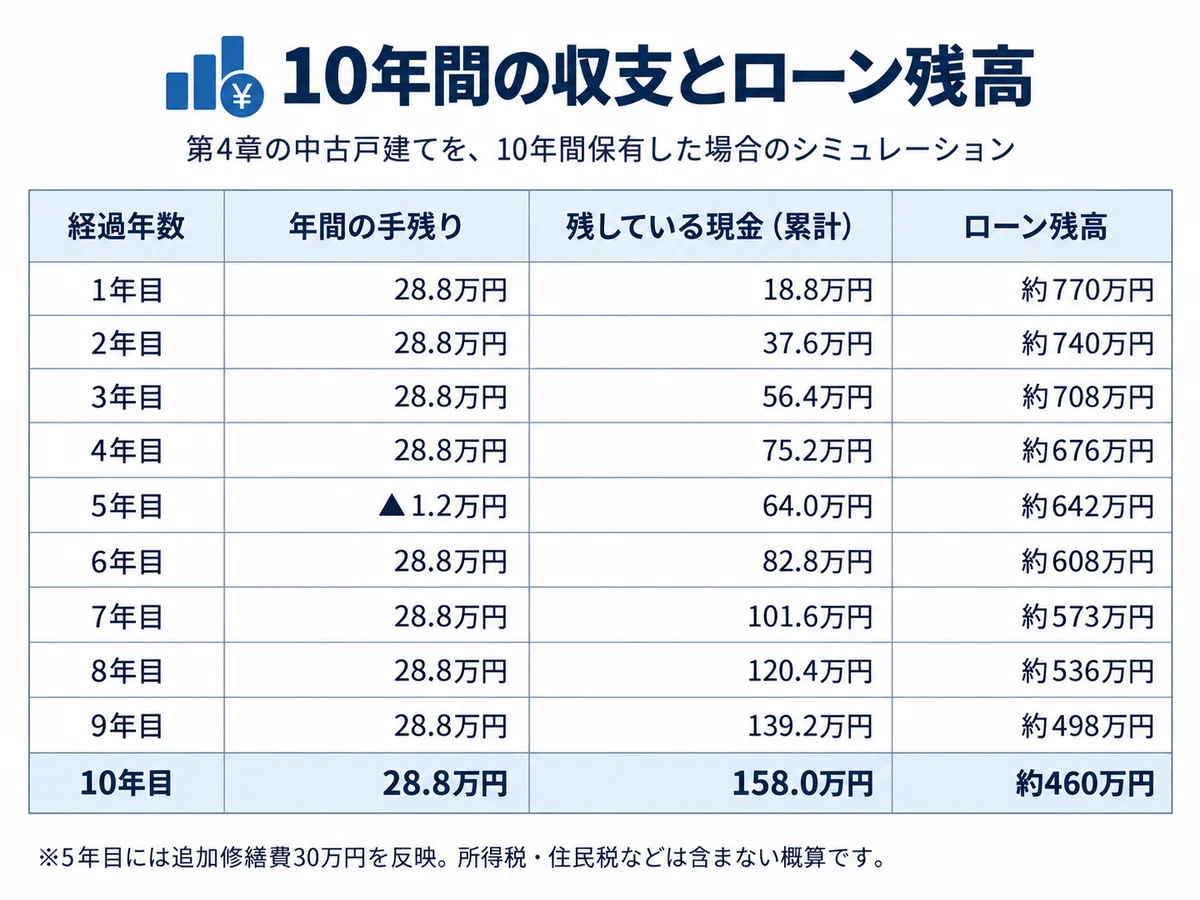
– Cash increased and debt decreased over 10 years
The results are summarized as follows:
① Cash balance
・Money used for living expenses: Total 1 million yen
・Cash saved for the future: approx. 1.58 million yen
② Loan balance
・At time of purchase: 8 million yen
・10 years later: approx. 4.6 million yen
・Loan principal reduced by repayment: approx. 3.4 million yen
In other words, while using 1 million yen for living expenses, you saved approximately 1.58 million yen in cash and reduced the loan balance by approximately 3.4 million yen.
– What happens to the remaining cash if you pay off the loan after 10 years?
For example, suppose you purchased a property at age 50, held it for 10 years, and received your retirement allowance at age 60.
What would happen if you used that retirement allowance to pay off the remaining loan balance of approximately 4.6 million yen in a lump sum?
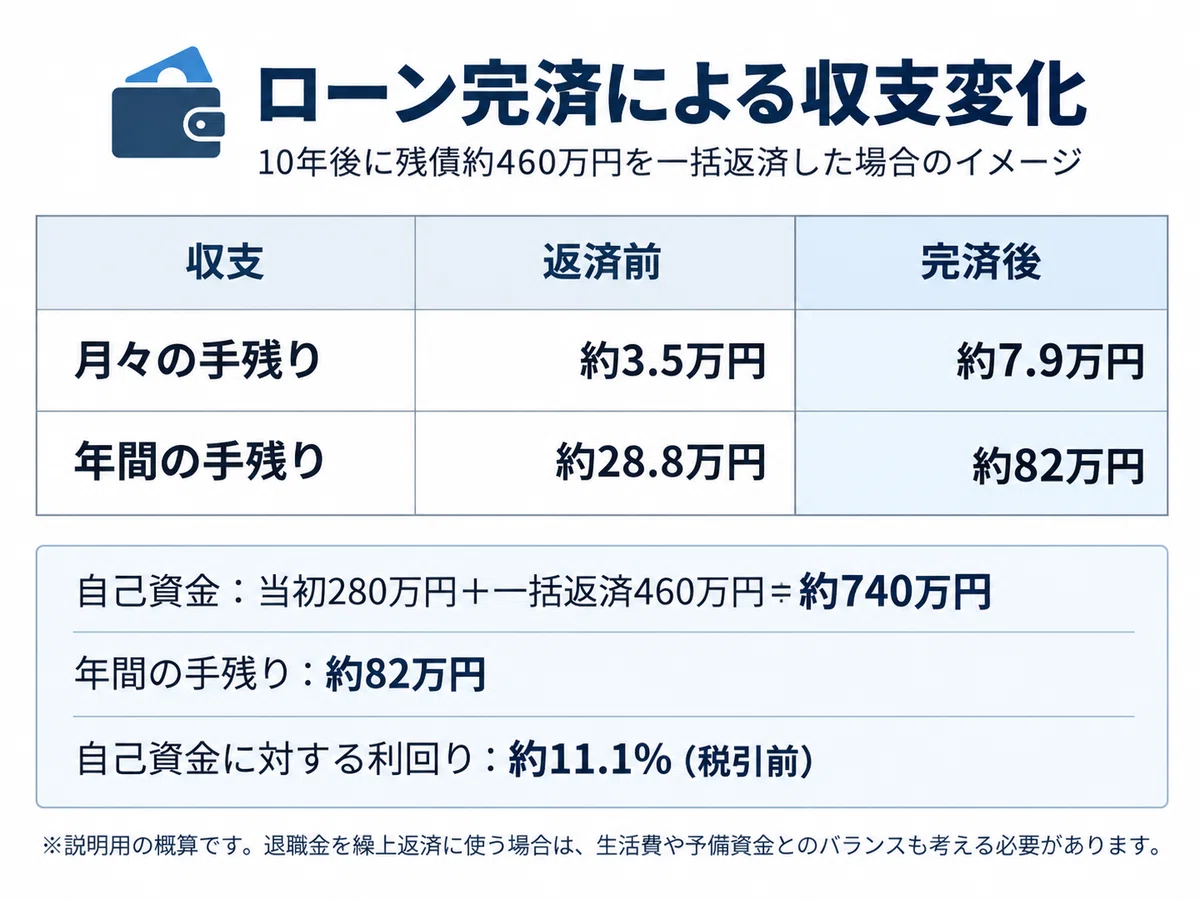
If you pay off the loan, your annual remaining cash will increase by approximately 530,000 yen.
Furthermore, when calculating the yield on initial investment, the yield on initial investment becomes approximately 11.1%.
If loan repayments disappear, the income generated from rent will increase significantly. This is also one of the attractions of holding real estate for the long term.
-Actual cash flow is not always as simulated
Of course, the figures here are hypothetical for illustrative purposes.
In reality, your take-home amount will vary due to factors such as the following:
-
Vacancies and rent decreases: Income decreases
-
Unexpected repairs: Expenses increase
-
Fluctuations in loan interest rates: Interest burdens and repayment amounts change
-
Income tax and resident tax: Tax burdens arise based on real estate income
*Detailed simulation methods including these factors will be introduced in future articles.
*When considering lump-sum repayment using retirement funds, you must also balance it with your living expenses for retirement.
Leveraging the 10-year timeframe to reduce the loan balance while increasing future income.
I believe having such options is also a key appeal of real estate investment.
So, how do you apply this income to your own life?
In the next chapter, we will introduce the concept of “Pension FIRE,” which combines public pensions with income revenue.
6. Integrating Rental Income into Daily Life | “Pension FIRE” Through Pensions and Income
-Another source of income brings peace of mind
For example, if you are a bit anxious about relying solely on your pension, adding rental income could cover the shortfall.
Using your pension to support daily life and your rental surplus to enjoy travel or hobbies can add color and comfort to your life.
Above all, the most gratifying part is that the anxiety of “Will I have enough money?” gradually turns into the anticipation of “What shall I enjoy next?” isn’t it?
-Pension FIRE | Choosing Your Own Way of Working and Living
What Income Jr. aims for is “Pension FIRE,” which uses public pensions and income from real estate and bonds as the foundation for life.
The goal is not necessarily to quit working.
“I like my job, so I’ll continue a little longer.”
“I’ll reduce my working days to spend more time on hobbies and with family.”
In this way, you can choose how you work and live from age 65 onwards.
Instead of making increasing money the goal, you transform it into life choices and freedom of time.
That is the “Pension FIRE” envisioned by Income Jr..
Summary | Beyond Increasing Money.
In this article, we have looked at the mechanics of real estate investment, the flow of money until rental income remains in your hands, and the changes over 10 years.
What I wanted to convey through this article is not simply whether real estate investment is profitable.
How rental income is generated, how much remains in your pocket, and how it serves your daily life.
It is about understanding that mechanism, thinking for yourself, and becoming able to make your own decisions.
I am a 56-year-old company employee and an active landlord myself. I am still in the middle of learning.
That is precisely why, through this media, I want to grow the ability to learn and judge income generated from real estate and bonds together with all of you who have walked through the same era.
In the future, I plan to share information on how to choose investment properties, simulate income and expenditures, and discuss interest earned from bonds, while incorporating concrete examples and figures.
Finally, please imagine just one thing.
If you had monthly income you could use in addition to your pension, what would you want to do?
Whether to continue working, take a little break, or challenge yourself with something new—you choose for yourself.
Let’s think together about what we can do now for such a future.
Beyond growing your money.