When you think about building a rental property from the ground up for real estate investment, what is the first thing you do?
Search for land for sale on real estate portal sites.
Compare land prices and areas.
Look for land that seems to have a good yield.
Of course, those are also ways to search for land.
However, if you are planning a new rental housing project from the ground up,
I believe there are things you should do before you suddenly start looking for land.
That is, deciding on the conditions to judge what kind of land fits your investment plan.
When you start looking for land, various properties will catch your eye.
There are many that look attractive, such as land with low prices, large plots of land, land near stations, or land in a corner of a residential area.
However, even if the price is low, you may not be able to fit the building you want to build, you may not be able to secure the necessary parking spaces even if the land is large, or costs other than the purchase price may become high.
It may be too late if you notice problems after buying the land.
While working in design in the construction industry, I have been involved in everything from land acquisition to the construction of new detached rental houses and operation after completion.
Through that experience, I feel that in searching for land, it is important not only to “find good land,” but also to be in a state where you can judge land that is worth purchasing for yourself.
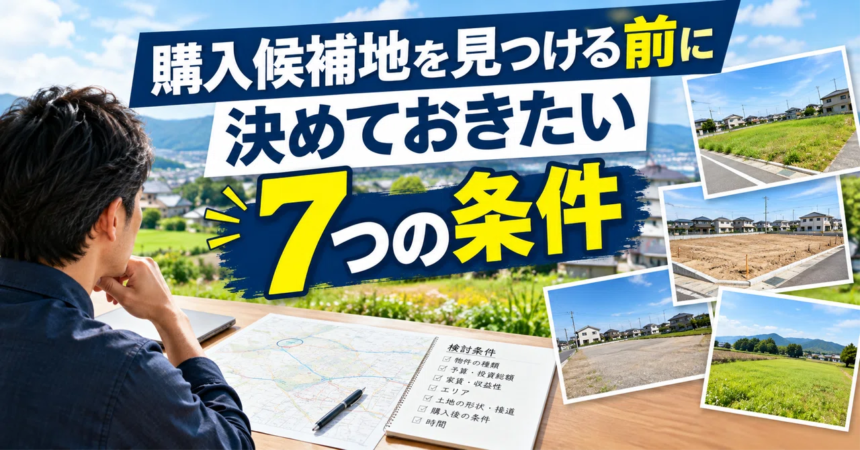
This time, I will explain 7 conditions that you should organize before you start looking for candidate sites when starting real estate investment from land in regional areas.
1. The first thing to decide is what kind of rental property to build
When people talk about searching for land, they tend to look at the land itself first.
However, land itself does not generate revenue.
If you are going to build rental housing, you need to think about what kind of building you will build on that land, who you will rent it to, and how you will earn revenue.
For example, even for the same land, the required site area, parking layout, construction costs, and assumed tenant demographics differ between planning a detached rental house and building an apartment building.
For a detached rental, securing a floor plan and parking spaces assuming a family demographic might be important.
On the other hand, for a multi-unit housing complex for single people, access to stations and commercial facilities, the number of units, and the planning of common areas may be important.
In other words, before looking for land, you need to organize what kind of rental property you want to build.
I have worked on new detached rentals myself, and when thinking about construction plans, it was essential to consider not only the price of the land but also the building layout, parking, and site shape together.
Instead of deciding on the land first and then thinking about the building, the order is to have an image of the building and then look for land that fits that plan.
For those who are about to start real estate investment, I think it is a good idea to first organize the following items.
-
Detached rental or apartment?
-
Who is the target tenant?
-
What size and floor plan are required?
-
How many parking spaces are needed?
-
Is new construction the premise, or will you also consider utilizing existing homes?
You do not need to finalize everything at this stage.
First, it is important to decide on the direction of the property you are aiming for.
2. Determine the maximum total investment amount, including land and construction costs
The next thing to consider is the amount of money available for investment.
When you start looking for land, you inevitably focus on the land’s selling price.
However, when planning a new rental property from land, the necessary funds are not just the land cost.
In addition to the construction costs for the building itself, expenses such as exterior work, equipment-related work like water and sewage, registration fees, loan-related fees, and various application fees may arise.
Depending on the site conditions, there is also a possibility that costs for land preparation, retaining walls, or ground improvement will be required.
For example, even if the land looks cheap, if the construction and infrastructure development required for building cost a large amount, the total investment may end up being high.
Conversely, even if the land price is somewhat high, if it is land where the building can be placed efficiently and additional construction can be kept to a minimum, it may be more advantageous for the project as a whole.
The important thing is not to judge based solely on the price of the land.
Before looking for land, consider the maximum total investment amount, including the following types of costs.
Cost Item Main Confirmation Details Land Acquisition Cost Land price, brokerage fees, etc. Construction Cost Building itself, equipment, necessary incidental work Exterior Cost Parking, paving, fences, drainage, etc. Infrastructure-related Water/sewage, electricity connection status Miscellaneous Expenses Fees related to registration, loans, applications, etc. Reserve Fund Provision for additional construction and unexpected expenses
What to be careful about here is that the same costs do not occur for every piece of land. The specific necessary costs vary depending on the land situation, construction plan, contract conditions, etc.
Therefore, it is realistic to set an estimate in the initial stage of land searching and proceed with quotes and on-site confirmation once a potential purchase site is found.
Also, when deciding on the total investment amount, it is important not to assume that you will use up all your available funds.
You also need to consider operating funds after purchase, as well as preparations for vacancies, repairs, and interest rate increases.
3. Think by calculating backward from the rent, not the land price
Once you have determined the upper limit of your total investment, the next point to consider is the level of rental income you can expect.
For example, even if you can purchase land cheaply, if there is not enough rental demand in that area, there is a possibility that you will not be able to secure tenants at the assumed rent.
A low land price and a good investment are not necessarily the same thing.
Therefore, before looking for land, you should form a certain hypothesis about the rent and tenant demographic of the assumed rental property.
Points you want to check include, for example, the following:
-
What kind of rental properties are in the vicinity
-
How much are properties with similar floor plans being advertised for
-
How does the presence or absence of a parking lot affect the rental conditions
-
What kind of tenants can be expected, such as families or single people
-
What are the surrounding living convenience facilities and commuting/schooling environments like
However, the rent posted on rental websites is not necessarily the actual contract rent.
It is dangerous to look only at the asking price and assume that you can definitely rent it out for that amount.
Also, you want to avoid making investment decisions based solely on the gross yield.
You can calculate the gross yield by dividing the annual rent by the total investment, but from there, you need to consider management fees, taxes, insurance premiums, repair costs, income loss due to vacancies, and loan repayments.
At the land-hunting stage, it is important to confirm with a margin of safety whether the business will be viable even if the assumed rent drops slightly or construction costs rise.
Instead of aiming to buy land cheaply, look for land that can realize a sustainable rental business.
Having this mindset makes it easier to avoid decisions driven solely by price.
4. Do not spread your search area too wide from the start
In land hunting, how you decide on the target area is also important.
If you expand your investment targets, the number of candidate sites may increase.
However, the wider the area, the wider the scope of research into rental demand, rent market prices, land prices, construction costs, and regional regulations.
If you are engaged in real estate investment while continuing your main job, the time you can spend on research is limited.
Therefore, rather than targeting land across the entire prefecture from the start, I recommend narrowing down your candidate areas based on several conditions.
For example, there are perspectives such as the following.
Rental demand
Consider what kind of rental demand can be expected based on population, household composition, employment environment, surrounding facilities, and so on.
Just because an area has a large population does not necessarily mean it is advantageous; compatibility with the type of property and rent range is also important.
Land price
Based on the assumed rent and construction costs, consider the range of land prices that would make the project viable.
Ease of management
If you are balancing this with your main job, whether the distance allows you to reasonably perform on-site checks, handle repairs, and coordinate with management companies is also a factor in your decision.
Competing properties
Investigate how many similar rental properties are in the vicinity and under what conditions they are being advertised.
In my case as well, when searching for land, it was important to have a perspective not just on price, but on what kind of building could be planned for that land and whether it would be viable as a rental property.
There is no single correct answer for choosing an area, but narrowing your target to a range you can investigate is also useful for making effective use of your limited time.
5. Consider not only the area, but also the shape of the land and road access conditions
Even if the price and area of the land meet your requirements, that alone does not mean it can be a candidate for purchase.
Especially when the purpose is to build a structure, the shape of the land and its relationship to the road are important.
For example, even if a plot of land has sufficient area, if it has a long, narrow, or irregular shape, it may be difficult to arrange the building or parking lot.
Depending on how it connects to the road, it is necessary to check road access requirements under the Building Standards Act.
It is recommended to consult a professional for detailed requirements.
(It is difficult to cover all laws and regulations. I will write about this later as well.)
Also, the width and type of the road, as well as the elevation difference from the site, may affect the plan.
Furthermore, it is dangerous to look only at the building coverage ratio and floor area ratio and assume that you can build a structure that fills the entire site.
In reality, it is necessary to consider road conditions, site shape, parking, building layout, and various laws and regulations together.
Before you start looking for land, you should at least be aware of the following points.
-
Is the shape suitable for placing the desired building?
-
Is it likely that the necessary parking can be secured?
-
Are there any issues with how it connects to the road?
-
Is there a difference in elevation between the site and the road?
-
Can conditions such as building coverage ratio and floor area ratio be verified?
-
Can the status of infrastructure such as water and sewage be verified?
Of course, these cannot all be finalized at the stage of identifying potential sites.
However, if you understand in advance what points should be checked, it becomes easier to avoid making judgments based solely on price or appearance when you find a piece of land.
6. Decide on conditions to avoid trouble after purchase
When searching for land, it is easy to focus your attention on finding land that you can purchase.
However, what is truly important is whether you can proceed with the project as planned after purchasing the land.
If unexpected problems are discovered after purchase, additional costs may arise, or it may become necessary to revise the construction plan.
For example, the land category, rights relationships, boundaries, water and sewage conditions, and elevation differences are all things that need to be checked for each individual plot of land.
Also, there are problems that cannot be judged by the appearance of the land alone.
It is important not only to check the site in person, but also to verify registration information and administrative documents, and to consult with experts and relevant agencies as necessary.
The important point here is that investigating after finding a piece of land is not in itself a bad thing.
However, if you proceed with purchase discussions without knowing what needs to be investigated, there is a risk of overlooking important confirmation items.
Therefore, before you start looking for land, organize your own checklist of items to confirm.
I believe that when deciding whether to purchase land, it is important to have multiple perspectives, not just “is the price cheap?” but also “can the construction plan be realized?”, “will unexpected costs arise?”, and “is it viable as a rental business?”
7. Finally, decide on the amount of time you can dedicate to searching for land
A point often overlooked in the land search process is the issue of time.
When planning a new rental housing project from the land up, various tasks arise beyond just searching for potential sites, such as on-site inspections, document research, administrative inquiries, architectural planning, cost estimation, loan consultations, and contract procedures.
If you have a full-time job, it is not easy to handle all of these tasks by yourself.
That is why it is important to consider how much time you can secure before you start looking for land.
For example, you might consider a process that fits your lifestyle, such as gathering information and reviewing documents on weekdays, and conducting on-site inspections on weekends.
You should also consider whether you really need to perform every task yourself. Depending on the content, consulting with professionals such as real estate agents, architects, land and house investigators, or administrative scriveners can improve the accuracy of your checks and streamline your work.
However, since hiring professionals also incurs costs, it is a good idea to think about which parts you will handle yourself and which parts you will outsource.
Searching for land does not always yield results in a short period of time.
There is no guarantee that you will find land that meets your desired conditions immediately, and there may be times when you decide against a purchase after investigating a potential site.
Therefore, it is important to create a system that allows for continuous investigation rather than rushing into a purchase decision from the start.
Checklist before starting your land search
I have organized the points introduced so far so that you can review them before you actually begin your land search.
You do not need to finalize all conditions from the very beginning.
I recommend writing down your thoughts first and then reviewing them as needed once you have found a potential site.
-
You have decided what kind of rental property you want to build
-
You have considered your target tenant demographic
-
You have considered the maximum total investment amount, including land, construction costs, and miscellaneous expenses
-
You have researched expected rent and rental demand
-
You have narrowed down your target investment area to some extent
-
You have considered the necessary site area and parking conditions
-
You understand the items that need to be checked before purchase, such as building regulations and road access conditions
-
You are considering preparations for vacancies, repairs, interest rate hikes, etc.
-
You have secured time to spend on searching for and investigating land.
-
You have also decided on the conditions for passing on a purchase.
The last point, “conditions for passing on a purchase,” is particularly important.
When you are searching for land, you may find yourself feeling a strong desire to purchase it somehow once you find a plot that is close to your ideal.
However, in investment decision-making, you need to organize not only the reasons to buy but also the reasons not to buy.
For example, passing on a purchase is an option if the planned building cannot be placed, if the necessary parking space cannot be secured, if the balance sheet does not work out due to additional costs, or if important legal rights cannot be confirmed.
If you decide on your conditions in advance, you will be less likely to be swayed by the appeal of the land and will be able to make decisions more calmly.
Summary: Prepare to make good decisions before searching for good land
In searching for land for real estate investment, there is a tendency to focus on finding cheap land or land with good conditions.
However, if you are planning a new rental housing project from the land up, you need to consider not only the price of the land but also various factors such as building plans, total investment amount, rental demand, regulations, and maintenance.
Before you start searching for land, organize what kind of property you want to build, how much you can invest, and what conditions you would require to make a purchase.
This preparation will help you make decisions when you find a piece of land.
I myself have been working on land searching and new detached rental housing while possessing professional architectural knowledge, but each piece of land has different conditions, and the same judgment does not necessarily apply to every case.
That is why I believe it is important to have judgment criteria in advance and to perform the necessary checks for each potential site.
And there is one more important stage in searching for land.
That is, beyond just comparing land that is generally on the market, how to find potential sites that fit your investment plan and how to examine the possibility of purchasing them.
In the next article, before moving on to the practice of searching for land, I would like to delve deeper into the mindset for finding potential sites.
The search for land does not begin the moment you find the land.
I believe it begins the moment you decide what constitutes good land for you.