The European Central Bank are set to increase interest rates once more – here’s everything you need to know about the hikes and how they will affect your mortgage repayments

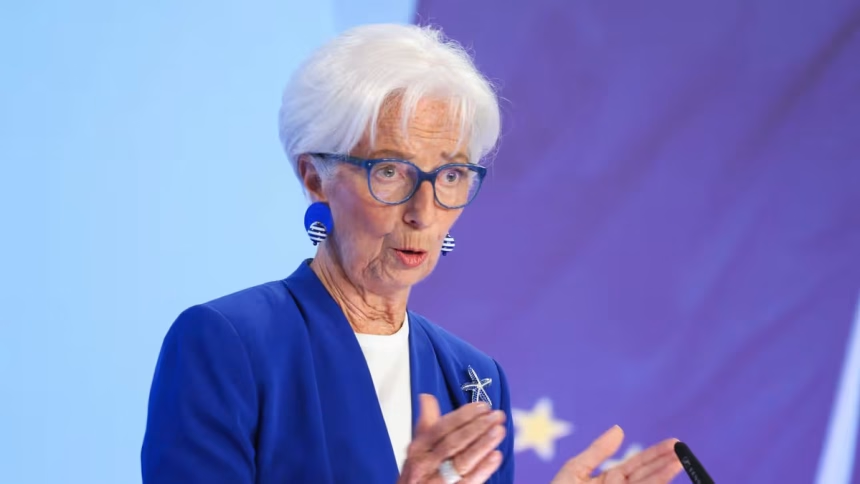
Christine Lagarde, president of the European Central Bank (ECB), during a rates decision news conference in Frankfurt, Germany, on Thursday, June 11, 2026(Image: Alex Kraus/Bloomberg via Getty Images)
Today, the European Central Bank confirmed it is raising interest rates by 0.25%. This will result in people’s mortgage repayments increasing, with those on tracker mortgages and non-fixed interest rates affected.
The move, announced today but long anticipated, brings the ECB’s deposit interest rate to 2.25 per cent. Meanwhile, the bank’s main lending rate, which is linked to tracker mortgages, increased to 2.4 per cent.
This means that Irish households who are not on a fixed rate mortgage will see their monthly mortgage repayments increase – and those on tracker mortgages will also be affected.
This is the first interest rate increase in almost three years and comes as the Iran war is continually putting pressure on economies worldwide, as well as disrupting energy supplies.
Financial experts believe another interest rate hike could be on the cards this year, amid increased geopolitical uncertainty.
The ECB noted in a statement that the economic outlook remains very uncertain, explaining that they are trying to stabilise inflation at their 2% target.
“The Governing Council is committed to setting monetary policy to ensure that inflation stabilises at its 2% target in the medium term. In line with this commitment, it today decided to raise the three key ECB interest rates by 25 basis points,” the ECB said in a statement.
“The war in the Middle East is generating inflation pressures, and the decision to raise rates is robust across a range of scenarios mapping out how the shock might evolve and affect the medium-term outlook for the euro area.
“In the baseline of the new Eurosystem staff projections, headline inflation is expected to average 3.0% in 2026, 2.3% in 2027 and 2.0% in 2028.
“The outlook remains uncertain, with upside risks for inflation and downside risks for economic growth. The full implications of the war for medium-term inflation and growth will depend on the intensity and duration of the energy price shock, as well as the scale of its indirect and second-round effects.
“This uncertainty is also reflected in the broad range of outcomes for inflation and growth in the updated illustrative scenarios put together by Eurosystem staff. These will be published with the staff projections on the ECB’s website.
“With today’s decision, the Governing Council remains well positioned to navigate the uncertainty caused by the war. It will closely monitor the situation and follow a data-dependent and meeting-by-meeting approach to determining the appropriate monetary policy stance.
“In particular, the Governing Council’s interest rate decisions will be based on its assessment of the inflation outlook and the risks surrounding it, in light of the incoming economic and financial data, as well as the dynamics of underlying inflation and the strength of monetary policy transmission. The Governing Council is not pre-committing to a particular rate path.”
Want to see more of the stories you love from RSVP ? To add RSVP as a preferred source of news on Google, simply click here