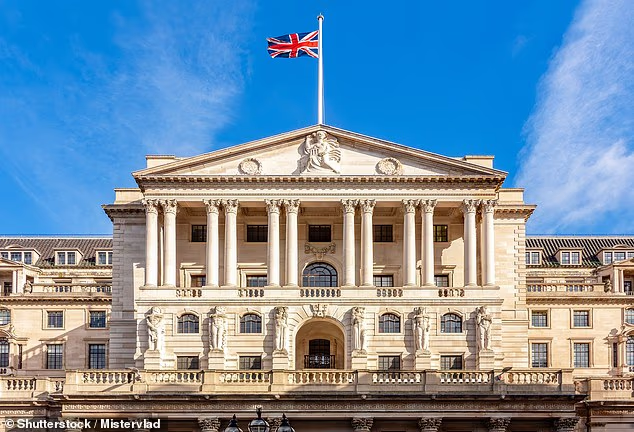
The Bank of England opted to hold interest rates at 3.75 per cent last month.
Seven members of the Bank’s Monetary Policy Committee voted for a hold, while two voted to increase the base rate by 0.25 percentage points to 4 per cent.
It was the fourth time in a row the MPC opted to hold, meaning base rate has now stayed the same since December 2025. The next decision is scheduled for 30 July.
The central bank had been cutting rates gradually from a high of 5.25 per cent since August 2024.
Policy makers remain worried about inflation which was up 2.8 per cent in the 12 months to May, above the central bank’s 2 per cent target.
Andrew Bailey, governor of the Bank of England said that they are ‘not complacent’ and that he is not happy about the fact that inflation is above target at all.
However, he also conceded that they are operating against a ‘softer economy.’

Status quo: The Bank of England has held base rate at 3.75% all this year
The Bank of England uses interest rate rises as a lever to curb borrowing and spending when inflation gets too high, so when inflation is falling, this gives it headroom to reduce rates.
Increasing interest rates is one way to reduce inflation, as it makes people less likely to spend or borrow money and more likely to save.
> Check mortgage rates with This is Money and L&C’s mortgage calculator
What next for interest rates?
In December, the bank cut interest rates from 4 per cent to 3.75 per cent, down from a high of 5.25 per cent the previous year.
The Bank of England then opted to hold interest rates at 3.75 per cent for the next four decisions that have so far taken place in 2026.
The next decision will take place on 30 July, with the majority of analysts now thinking a rate hike is more likely.
Traders are currently betting on one 0.25 percentage point interest rate hike in the second half of the year, with a remote chance of a further 0.25 percentage point increase early next year.
This means that based on financial markets, an interest rate hike to 4 per cent is the most likely outcome by December.
It’s worth pointing out that after the Bank of England’s rate decision in April, traders were betting on two or three interest rate hikes by the end of the year – so market forecasts have calmed somewhat.
However, many economists seem confident the Bank of England will simply hold rates where they are for the foreseeable future.
Both economists at Oxford Economics and Capital Economics have forecast that interest rates will stay at 3.75 per cent.
In fact, economists at both organisations now expect interest rate cuts to restart in late 2027.
In fact, those at Capital Economics, think base rate will be at 3 per cent by the end of 2027.
‘We continue to expect the next move to be a cut,’ said Andrew Goodwin, chief UK economist at Oxford Economics. ‘Our current baseline shows cuts resuming in late 2027, with the committee erring on the side of caution about underlying inflation pressures.
‘But the chances of an earlier move are rising. Cutting sooner would require oil and gas prices continuing to fall back. It would also require labour market conditions to remain loose.
‘But given the Middle East situation remains so uncertain, and that it’s advantageous to keep financial conditions relatively tight, we don’t expect there to be much discussion about rate cuts in the MPC’s communications for the time being.’
The base rate and the Bank of England
The Bank of England moves what is officially known as bank rate but more commonly called base rate to try to control inflation.
Base rate is the single most important interest rate in the UK. It determines the interest rate the Bank of England pays to commercial banks that hold money with it and therefore influences the rates those banks charge people to borrow money or pay on their savings.
The theory is that raising interest rates lifts the cost of borrowing for individuals and businesses and thus reduces demand for it, slowing the flow of new money into the economy and applying the brakes.
In contrast, cutting interest rates lowers the cost of mortgage rates and other borrowing and increases demand, pushing the accelerator on the economy.
Higher savings rates also make saving more attractive, while lower rates encourage spending over setting money aside.
The MPC sets interest rates to try to keep consumer prices inflation (CPI) at the Bank and Government’s 2 per cent target.
Aside from inflation, the central bank will also be keeping a close eye on economic growth and unemployment this year.
When growth is sluggish and unemployment high it depresses future inflation expectations. If the Bank believes this will ultimately push inflation below target, it can use interest rate cuts to encourage investment and hiring, as it makes borrowing cheaper.
> Interest rate rise and fall calculator: How moves affect your payments

The Bank of England is no longer expected to cut interest rates this year
What’s happened to inflation and interest rates?
A major inflation spike over recent years saw CPI rocket into double-digit territory, driven by the aftermath of the disruptive Covid lockdowns combined with an energy price crisis triggered by Russia’s invasion of Ukraine.
This saw the Bank of England raise base rate rapidly from its record low of 0.1 per cent, reached during the Covid pandemic years.
The first move up to 0.25 per cent came in December 2021 and a sharp series of rises from the MPC followed, driving base rate all the way up to 5.25 per cent in August 2023.
Rates were then held at 5.25 per cent until August 2024 until they were gradually cut to 3.75 per cent where they remain today.
Inflation was 2.8 per cent in the 12 months to May. While it still sits higher than the Bank of England’s 2 per cent target, the Office for Budget Responsibility (OBR) expects inflation will eventually fall to the Bank of England’s 2 per cent target in 2027.

Cause and effect: Inflation and wage growth are both factors that could determine what the Bank of England will do with base rate in the future
What a base rate cut would mean for savings and mortgage rates
Many people assume that savings rates and mortgage rates are directly linked to the Bank of England base rate.
In reality, future market expectations for interest rates and banks’ funding and lending targets and appetite for business are what really matters.
Market interest rate expectations are reflected in swap rates. A swap is an agreement in which two banks agree to exchange a stream of future fixed interest payments for another stream of variable ones, based on a set price.
These swap rates are influenced by long-term market projections for the Bank of England base rate, as well as the wider economy, internal bank targets and competitor pricing.
In aggregate, swap rates create a benchmark of where the market thinks interest rates will go – though they can shift quickly in light of economic changes.
Mortgage rates have been falling in recent weeks as a result of swap rates falling.
As of 1 July, two-year sonia swaps are 3.96 per cent and five-year swaps are 4.02 per cent.
To put that in context, that’s lower than they were in March and April – for example, on 20 March, two-year swaps were at 4.34 per cent, but they remain higher than they were prior to the Iran conflict. Two year swaps were 3.36 per cent on 27 February.
Meanwhile, five-year swaps were at 4.23 per cent on 20 March, but were 3.41 per cent on 27 February.
It means two-year and five-year swaps remain higher than at the start of the conflict and until they fall further, mortgage rates will also remain higher than they were earlier in the year.
Longer term, any borrowers hoping for a return to the rock bottom interest rates of 2021 will likely be disappointed. However, savers will be reassured that rates are not expected to plummet to the depths of 2021 anytime soon.
Richard Carter of Quilter Cheviot says: ‘Swap rates are a useful indicator of current expectations, but it is important to remember they are no better at predicting the future than any other economic indicator. The economic outlook can change very quickly and very dramatically.’
> Saving and banking: Read the latest on savings rates and top deals

Sticky: Higher than expected inflation could result in MPC members including Andrew Bailey (pictured) refraining from rate cuts in the future
What should savers do?
If the base rate doesn’t fall again in 2026, or even goes up slightly, savings rates should stay higher for slightly longer.
Savers can still get over 4 per cent in an easy-access savings account and the best fixed rate savings pay more than 4.5 per cent.
The good news is that with inflation at 2.8 per cent, it means savers who hold their cash in the top paying accounts could still be making a real return, before tax – but it’s very marginal.
Our savings tables show the best easy-access savings, top cash Isas and fixed rate savings deals.
The advice to savers has been to keep on top of the changing market if they want to secure a competitive deal.
> Sign up to our savings alerts and be the first to find out about top deals
What should mortgaged households do?
The lowest fixed rate mortgages all remain firmly above 4 per cent, but there are some deals below 4.5 per cent.
For those due to remortgage this year, the first thing to do is to make sure they’re moving to the best deal available. This means speaking to their broker or their lender and locking in a new rate as soon as possible.
It is possible to reserve a new mortgage rate as early as six months before your current one ends.

Lock in now: David Hollingworth, associate director of L&C Mortgages says that securing a rate ahead of your deal ending will protect you against further increases
If the situation changes and rates begin to fall again, it is usually possible to abandon it in favour of a new one until just before the new mortgage begins.
‘Anyone considering their mortgage options will unfortunately be under pressure to make a quick decision or risk having to accept a higher rate,’ says David Hollingworth, associate director at L&C Mortgages.
‘Securing a deal will protect against further rate rises but if rates do ease back in time, there’s still a chance to review before completion and move to a lower rate at that time.’